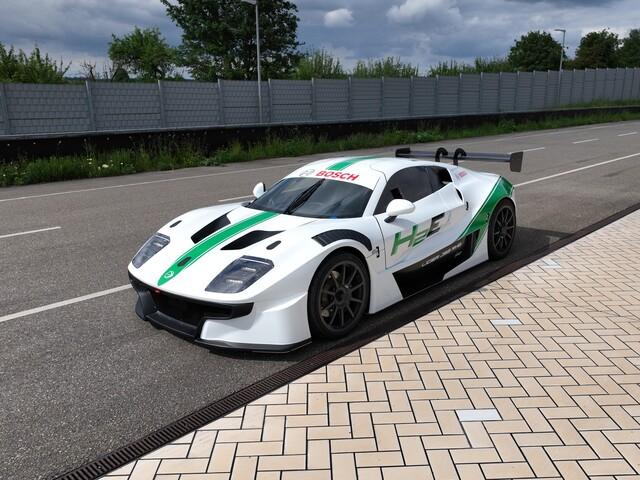
In the project, Bosch Engineering oversaw the overall vehicle design and played the key role in developing the concept for engine and tank system, and a comprehensive multistage hydrogen safety system. Ligier Automotive was responsible for the global vehicle dynamic performance, the design of the monocoque, and the chassis adaptation of its existing Ligier JS2 R. They also optimized the mechanical components for use with hydrogen and led their overall integration into the new vehicle. The vehicle features a V6 hydrogen engine and a carbon monocoque that integrates three 700-bar type IV hydrogen cylinders from Hexagon Purus. These tanks match the requirements on the dimensions, performance, and safety for the high-performance demonstration vehicle. The 3.0-liter biturbo charged V6 engine already has an output of 420 kilowatts and will be optimized even further in the coming weeks. It is based on a volume-production gasoline power unit that the experts at Bosch Engineering have converted for use with hydrogen. In particular, this involved adapting the ignition and the entire injection system. Not only does the engine concept ensure very lean combustion, with especially low nitrogen oxide emissions up to partial load. It also delivers a very high specific output. Another challenge while developing the engine was to achieve stable combustion without preignition at high loads and engine speeds of over 7,000 rpm.